Why traditional sales interviews are a weak hiring assessment
An interview measures how well someone prepares for an interview. Candidates come in polished, tell great stories about past deals, and seem exactly right. Then they get on a real call and freeze the moment someone pushes back.
The most expensive hires are the ones who interview beautifully. They clear every screen, get the offer, and cost you three months of ramp before anyone admits the fit isn't there.
See how candidates actually sell, not how they interview.
Every candidate runs the same live roleplay scenario against the same AI persona, scored against the same criteria.
What you're evaluating is real: how they handle an objection, whether they listen, how they recover when the call goes sideways. This is a pre-hire assessment tool built for sales specifically, not a generic skills test adapted from somewhere else.
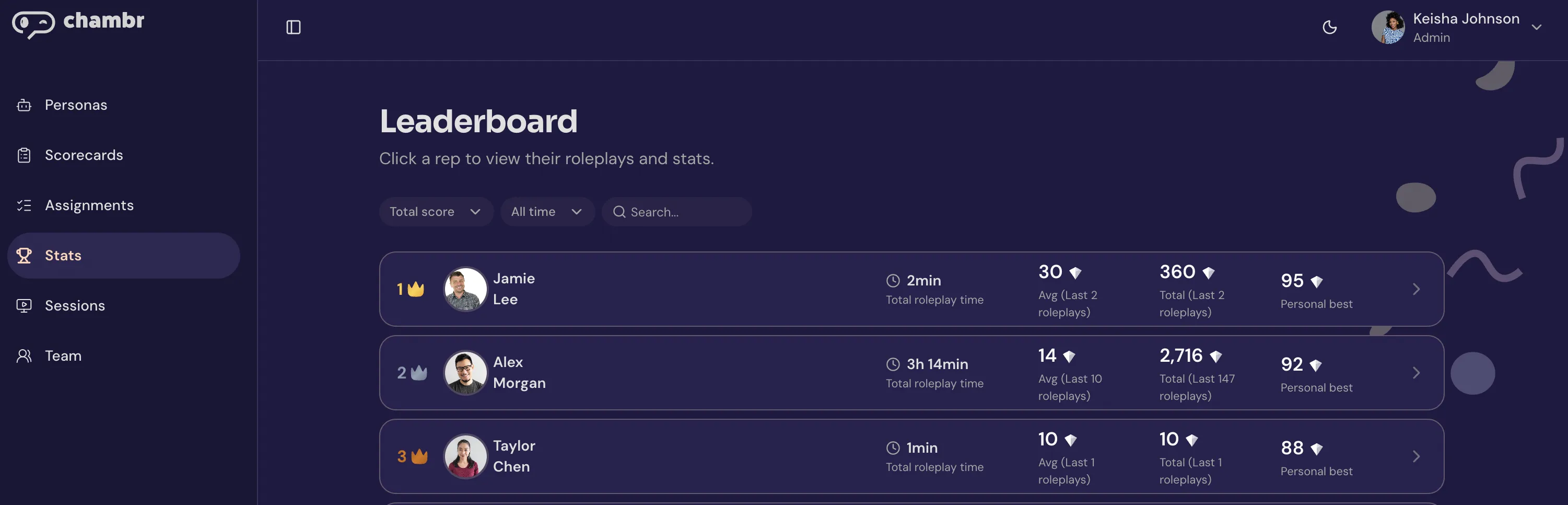
Chambr ranks every candidate who completes the AI roleplay on a shared leaderboard. Scores are objective. Comparison is instant. Hiring managers stop debating impressions and start making decisions based on who performed.
Some candidates run one session and stop. Some ask to go again. Some come back having clearly worked on what the AI flagged. The ones who disengage after one attempt tell you something too.
When candidates have already demonstrated they can handle a hard objection and take feedback before they're hired, they arrive at onboarding with the right baseline.
AI hiring assessment results from our customers
6 strong AEs hired directly through Chambr roleplay assessments
At Boundless, after adding a live session to the AE interview loop.
37% faster ramp at Fero
When Chambr was used across both hiring and onboarding. Coachability in the assessment predicted coachability on the job.
30% less remedial coaching needed after onboarding
At Frontline Selling, driven by reps who were hired and trained against the same standard from day one.
Chambr's AI platform has been an invaluable resource for our People managers at Notion.


Explore other use cases
See who's coachable before you hire them.
See what a Chambr hiring assessment shows you before you make an offer. Book a 30-minute walkthrough.
Frequently asked questions
How does Chambr's hiring assessment work?
Every candidate runs the same live roleplay scenario against the same AI persona, scored automatically against your criteria. Hiring managers see how each candidate handles pressure, objections, and recovery, then compare everyone on a shared leaderboard ranked by actual performance.
What does a Chambr roleplay assessment show that a standard interview doesn't?
A standard interview shows you how well someone prepared for the interview. A Chambr sales candidate assessment shows you how they perform when the conversation doesn't go as planned: whether they listen, how they handle a hard objection, whether they ask to go again after a rough session. At Fero, the best-looking candidates on paper often struggled most against a difficult AI persona. The ones who kept going were the ones worth hiring.
How does the Chambr candidate leaderboard work?
Every candidate who completes a Chambr roleplay assessment is automatically scored and ranked on a shared leaderboard. Hiring managers see performance across the full candidate pool at a glance: who handled objections well, who recovered under pressure, who improved across multiple sessions. Comparison is objective and instant. The shortlist makes itself.
Is a Chambr AI hiring assessment fair to candidates?
Yes. Fairness is one of the strongest arguments for it. Every candidate gets the same scenario, the same AI persona, and the same scoring criteria. There's no variation based on which interviewer ran the session, what mood they were in, or how the conversation happened to go. Traditional interviews introduce subjectivity at every step. Chambr removes it. Candidates who've experienced both consistently say the roleplay assessment feels more transparent and merit-based than a panel interview.
What's the ROI of using AI hiring assessments?
A bad sales hire typically costs between $100,000 and $150,000 when you factor in ramp time, missed quota, management hours, and replacement costs. Chambr is the filter that catches the wrong hire before the offer goes out. At Fero, managers saved 40-60 hours per month in coaching time because the hires they made needed less remedial work to reach competency. One bad hire avoided pays for a year of Chambr.
Can Chambr be used alongside an existing interview process?
Yes. Chambr adds a performance layer to your existing process without replacing it. Most teams run the Chambr assessment before or after the formal interview. Some use it as a pre-screen to filter candidates before they reach the hiring manager. Either way, the leaderboard and session scores sit alongside your existing evaluation, giving you more signal without adding more time to the process.
How does Chambr in hiring connect to faster ramp?
Candidates who pass a Chambr hiring assessment arrive at onboarding already familiar with the practice environment and already having demonstrated they can take feedback and improve under pressure. At Fero Logistics, using Chambr across both hiring and onboarding produced a 37% faster ramp on average. The coachability that showed up in the assessment showed up on the job too.
How long does it take to set up a Chambr hiring scenario?
Most teams have their first hiring scenario live within a day. You define the buyer persona, the objections, and the scoring criteria. If you already have a call scorecard, upload it and Chambr scores against it automatically. The same scenario used for onboarding practice can run as a hiring filter with no additional setup.